Hidden Snake: one neuron erases it on screen, not on paper
Plotted and photographed 27–28 November 2026 · Neuron plot 04 · Inkling 2 Mini · Tom White
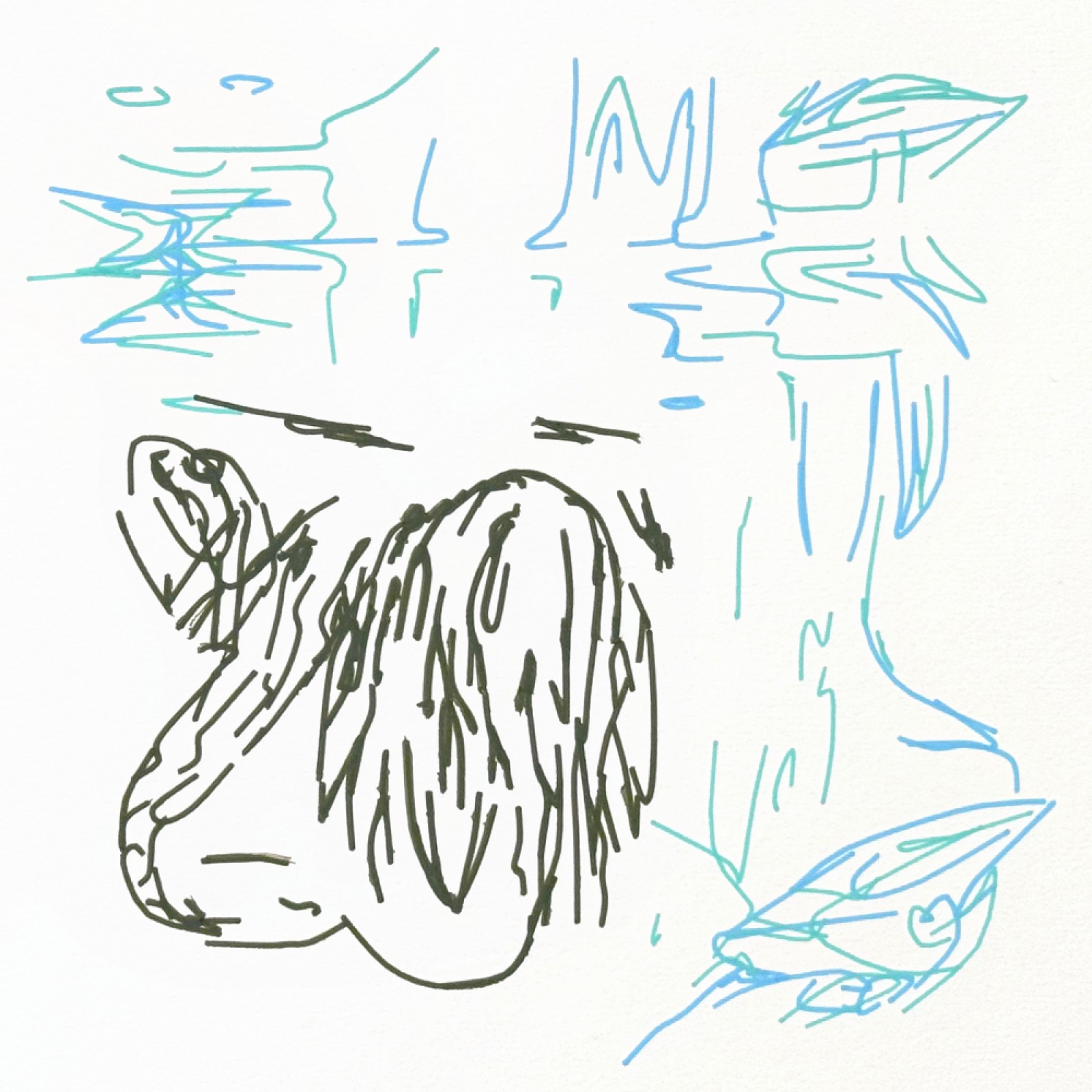
1. What this piece is, and what it showed
This page was grown for two neurons of a different model family, Inkling 2 Mini. One neuron fires on reflections in still water and was given the whole sheet. The other fires on coiled snakes and was given one corner and its own pen. The aim was a subject the model reports that depends on a single neuron: switch that neuron off and the snake should leave the description while everything else stays. On screen that is what happens. Mini says “A loose blue-and-olive line sketch of water reflections, mountains, a snake-like shape, feathers, and bird-like forms.” and, with the snake neuron off, “A loose colored line sketch of rippling water reflections above abstract organic shapes resembling foliage or animals.” The change is 3.1 times that of a stand-in, and the snake stays when the reflections neuron or any of 8 stand-ins is switched off instead. On paper the snake is still seen and the neuron still matters (3.0 to 12.8 times its stand-ins across three questions), but switching it off no longer removes the snake. The measured cause is the pen: the khaki marker draws a dark olive, far darker than the colour the page was grown with.
2. The target and the plot


3. The neurons
Coiled snakes m20:3673

Block 20 of the 23 blocks of Mini’s vision tower. The strip shows the photographs, out of 1,000 ordinary ones, where it reads highest. Switched off on its own strongest photographs it changes Mini’s output 12 times more than a stand-in. In the drawing it reads 1.09 times its strong-photo level inside the corner.
Reflections on still water m17:2213

Block 17. It fires on mirrored shapes over a waterline. In the drawing it reads 1.53 times its strong-photo level outside the corner and 0.29 inside it.
4. How the page was made
The page is 200 mm square with 200 strokes and 5.51 m of line in three pens: light blue (41 strokes), aqua green (47 strokes), khaki (112 strokes). The snake was first grown alone on its own page, then shrunk into a disc at the lower left (radius 30 % of the sheet’s width) and held near that shape while the reflections were grown around it. Grown from scratch in the corner, the snake was either too weak for Mini to mention or too convincing for one neuron to remove; the transplant was the recipe that worked.
It was plotted on an AxiDraw with Posca PC-3M markers. The khaki marker draws about 0.9 mm, so every khaki stroke was drawn twice, 0.25 mm apart, to reach the 1.1 mm the page was grown at (measured 1.16 mm). The blues were single passes.
Three photographs were tested. Two ordinary phone photographs read the snake ink as black, because the phone crushes dark tones. The third had a ColorChecker card in frame: corrected from the card’s six grey patches and a colour matrix (average patch error 2.7 of 255), the khaki ink is dark olive, #4a503d. The page was grown assuming #7d7a3c.
5. What the models say: screen against photograph
Inkling 2 Mini: answers with the snake neuron on and off
| Question | Answer | Answer with the snake neuron switched off | Effect | Snake gone? | |
|---|---|---|---|---|---|
| Describe this picture | screen | A loose blue-and-olive line sketch of water reflections, mountains, a snake-like shape, feathers, and bird-like forms. | A loose colored line sketch of rippling water reflections above abstract organic shapes resembling foliage or animals. | 3.1× | yes |
| photo | A loose abstract line drawing shows a dark snake-like form and feathery strokes beside teal water-like reflections and a small bird/fish-like shape. | A loose line sketch shows a snake-like figure beside a feathery central shape, with watery reflections and bird-like strokes around the edges. | 4.6× | no | |
| What can you see? | screen | A loose sketch collage of water reflections, mountains, a snake-like creature, feathers, and birds. | A sketchy line drawing of a watery landscape with reflections, mountains, and animal-like shapes. | 2.4× | yes |
| photo | A loose sketch shows a coiled snake beside feathery shapes, with water-like strokes and a tree-like form. | A sketchy line drawing of a snake, feathery figure, bird/duck, and watery landscape reflections. | 12.8× | no | |
| What is at the lower left? | screen | A coiled snake. | A snake. | 6.9× | no |
| photo | A coiled snake. | A coiled snake. | 4.7× | no |
The photograph rows use the version with the paper set to white. Left at the calibrated paper tone the result is the same: the snake neuron is 3.0 to 7.4 times its stand-ins and the snake stays in every answer. On the photograph the neuron beats all 8 stand-ins on every question, and at most the word “coiled” drops out.
Why it failed on paper: the pen
The same drawing was re-coloured on screen with only the snake pen made near-black. Mini still reports the snake (“A loose line drawing shows a black coiled snake beside a feathery black mass, with light-blue water-like refle”) and the snake neuron no longer removes it, at 3.1 times its stand-ins. That reproduces the paper result without a plotter.
Other pens, and another model
Re-colouring the khaki page with nine other pens never passed on the plain description: with light green, light orange, orange or grey Mini stops reporting a snake at all. Regrown for a green pen the page passes on screen (3.5 times, “A colorful line-art collage of sketches: lotus reflections and leaves at the top, a coiled” becoming “A collage of loose line sketches showing lotus flowers with reflections, plant-like forms,”), but the pass did not survive re-rendering the same strokes. That page was packaged and not plotted.
The snake neuron has a close match in Qwen3-VL-8B (correlation 0.94 over 1,000 photographs), but that model never reports a snake here: it calls the screen page “A child's sketch of a bear and a bird, drawn with simple lines and two colors.” and the photograph “A sketch of a dog with a fish in the water nearby.”
6. What did not hold, and what was not tested
- On paper the neuron does not remove the snake, on any of three questions and in either colour treatment. The on-screen result did not survive plotting.
- One plot and one page. Of four pages grown with the snake in its own khaki pen, this is the one that passed on screen.
- The page is fragile on screen too. Under plotter-style changes (pen width, a 3 degree turn, a small shrink or shift) the snake was always reported, but cleanly removed only as drawn and at one turn, in 6 variants tested.
- The pen colour was an estimate. The dark-pack khaki had never been measured before it was used; it draws #4a503d, not #7d7a3c. Slate grey from the same pack did the same on 26 November.
- The lines were drawn twice to reach their width, which the drawing was not grown for. The single-pass swatch is almost as dark, so the second pass is not the main cause.
- The snake is a literal picture of a snake. Whether an abstract subject would depend on one neuron more robustly was not tested.
- It is specific to one model family. The matching Qwen neuron exists and the Qwen 8B does not see the snake.