Aloft & Plait: two neurons on one plotted sheet
Plotted and photographed 25 November 2026 · Neuron plot 02 · Tom White
1. What this piece is, and what it showed
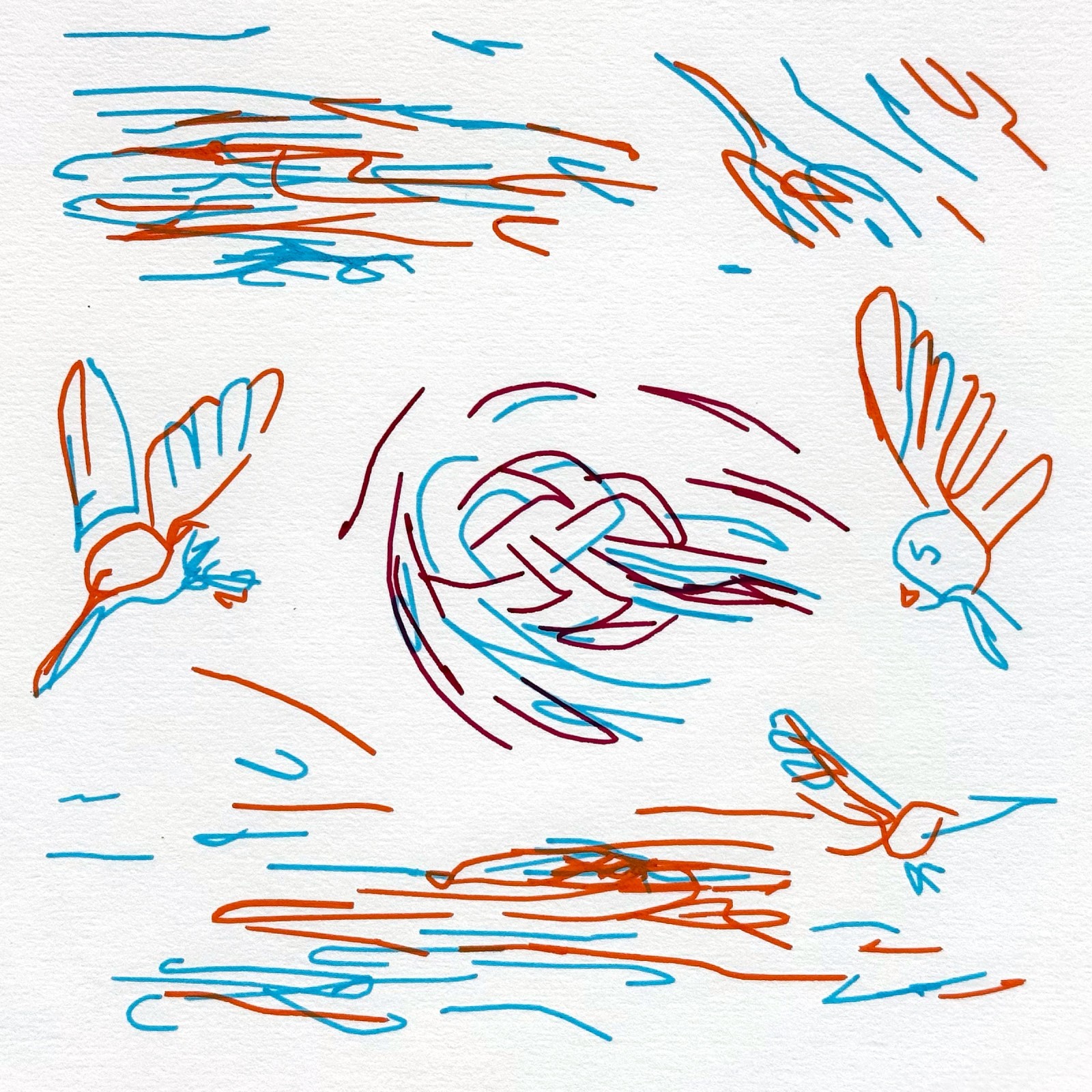
This page joins two drawings that were each grown for one neuron. Aloft fires on things up in the air, and its strokes became birds in flight across the whole sheet. Plait fires on interlaced strands, and its strokes are a knot, moved to the centre. The two were then gently re-grown as one page in three pens. On the photograph of the plot, both models read the page the way it was meant: birds around a knot, which they call a nest. The full 27B answers the question about the centre with “There is a nest in the center of this picture.” and, with the plait neuron switched off, “There is a bird in the center of this picture.” But the measured effect of that neuron on the centre answer is modest (1.9 times its stand-ins in the 27B, 1.5 in the 8B), and the Aloft neuron, although it fires far above its strong-photo level, never matters to the answer at all. This is the page that taught the project that a neuron firing is not the same as a neuron being used.
2. The target and the plot


3. The neurons
Aloft q27:21:559

Aloft sits in block 21. The strip shows the photographs, out of 2,000, where it fires hardest: things held up in empty space. It is a relation between a thing and the space around it, not a kind of object. The neuron at the same position in the smaller model follows it at a correlation of 0.73. Its strong-photo level is 12.86 in the 27B tower and 9.11 in the 8B.
Plait q27:16:1915

Plait sits in block 16 and fires on interlaced strands: braids, weaving, knots, wickerwork. It is compact and local, where Aloft is spread over a scene. Same position in the smaller model: correlation 0.80. Its strong-photo level is 3.31 in the 27B tower and 2.52 in the 8B.
4. How the page was made
The page is 200 mm square with 167 strokes and 5.82 m of line in three Posca PC-3M pens: light blue (85 strokes, 2.87 m), orange (62 strokes, 2.19 m), fuchsia (20 strokes, 0.76 m). It was “carved”: the birds come from a page grown for Aloft, the knot from a page grown for plait, and the joined page was then re-optimised a little, with Aloft rewarded over the whole sheet and plait only in the centre. The page was grown with a made-up blue halfway between the two source pages’ pens; before packaging it was re-read with real pens in its place, and light blue was chosen. Tom picked the final pens from renders made by the plotting session.
The plotting session measured the result: line widths of about 0.92 to 1.00 mm against a design width of 1.1 mm, no gaps found in the isolated lines tested, and the three pens registered to within about 0.4 mm of each other. The same session measured Tom’s real pen colours for the first time, which is where the project’s pen table comes from.
5. What the models say: screen against photograph
The neurons’ readings
| Aloft | Plait | |
|---|---|---|
| Strong-photo level, 27B tower / 8B tower | 12.86 / 9.11 | 3.31 / 2.52 |
| Screen page as packaged, 27B tower / 8B tower | 17.48 / 13.04 | 8.0 / 7.98 |
| Screen page at the worst of 24 turns | 9.88 / 10.58 | 6.73 / 7.36 |
| Photograph of the plot, full 27B model | 17.50 | 9.57 |
Both neurons fire on the photograph as strongly as on the screen page, and well above their strong-photo levels. The photograph’s reading in the smaller model’s tower was not recorded.
Qwen3-VL-8B: answers, and how much each neuron matters to them
| Question | Answer | Aloft | Plait | |
|---|---|---|---|---|
| Describe this picture | screen | A child's colorful scribble drawing of birds flying around a tangled nest. | 0.1× | 1.5× |
| photo | A childlike sketch of birds flying around a tangled nest, drawn with bold orange and blue lines. | 0.5× | 1.4× | |
| What is in the centre? | screen | A knot. | 0.4× | 1.0× |
| photo | A nest. | 0.2× | 1.5× | |
| Describe the knot or braid | screen | A colorful, swirling knot or braid made of pink and blue lines sits at the center of the drawing, surrounded by birds and water-like strokes | 0.7× | 2.1× |
| photo | A tangled, swirling knot made of maroon and blue lines, resembling a complex braid or knot in the center of the drawing. | 0.3× | 2.7× | |
| Describe the birds | screen | Three stylized birds in flight, drawn with simple lines in orange and blue, soar around a central pink and blue swirling pattern. | 0.8× | 1.5× |
| photo | Three stylized birds in orange and blue fly around a central knot-like shape, rendered in a loose, sketchy line art style. | 0.4× | 0.6× |
Each effect here is measured against 4 stand-ins. The screen rows use the page in the real pens as packaged. On the photograph the 8B says the centre holds “A nest.”, but the plait neuron is only 1.5 times its stand-ins for that answer (it beats 3 of 4), and 2.7 times when the model is asked to describe the knot. Aloft is below its stand-ins for every question. (Ledger entry 10.11.)
Qwen 27B: answers, and how much each neuron matters to them
| Question | Answer | Aloft | Plait | |
|---|---|---|---|---|
| Describe this picture | screen | This is a colorful, abstract line drawing featuring several stylized birds in flight, rendered in orange and teal, with dynamic, scribbled l | 1.2× | 1.1× |
| photo | This image displays a colorful, abstract line drawing featuring several stylized birds in flight, a central woven or knotted pattern, and sc | 0.9× | 12.6× | |
| What is in the centre? | screen | A bird. | 2.6× | 7.0× |
| photo | There is a nest in the center of this picture. | 0.2× | 1.4× | |
| Describe the knot or braid | screen | Based on the visual evidence, the central object is a complex, interwoven structure. The knot or braid in the picture is a tangled, multi | 0.6× | 13.9× |
| photo | The knot in the picture is a complex, interwoven braid with multiple strands looping and crossing over each other in a circular pattern. | 0.4× | 6.0× | |
| Describe the birds | screen | The picture shows four stylized birds drawn with simple, colorful lines in orange and blue, appearing to fly around a central abstract swirl | 1.4× | 2.8× |
| photo | The picture features four stylized birds drawn in a loose, sketchy style with orange and blue lines, appearing to fly around a central abstr | 0.8× | 5.2× |
Also against 4 stand-ins. The screen rows here use the page as grown, with the made-up blue, not the packaged pens. In the 27B the plait neuron clearly matters when the model describes the knot, on screen and on the photograph, and for the plain description of the photograph.
The photograph again in the 27B, with 8 stand-ins and the answer regenerated
| Question | Answer | Answer with plait switched off | Aloft | Plait |
|---|---|---|---|---|
| Describe this picture in one short sentence. | This image displays a colorful, abstract line drawing featuring several stylized birds in flight, a central woven or knotted pattern, and scattered horizontal strokes, al | This image displays a colorful, abstract line drawing featuring several stylized birds in flight, rendered with energetic blue and orange strokes on a white background. | 0.8× | 14.8× |
| What is in the centre of this picture? Answer in one short sentence. | There is a nest in the center of this picture. | There is a bird in the center of this picture. | 0.2× | 1.9× |
| What is around the edge of this picture? Answer in one short sentence. | birds | birds | 1.1× | 1.3× |
This later run (26 November) used the stricter version of the test. For the plain description, plait is 14.8 times its stand-ins and beats all 8 of 8: with it off, the “central woven or knotted pattern” drops out of the sentence. For the question about the centre the answer does change, from a nest to a bird, but the measured effect is 1.9 times stand-ins, under the bar of 3. (Ledger entry 10.10.)
6. What did not hold, and what was not tested
- In the 8B the photograph gets the right words (“A nest.”) without the plait neuron being what carries them: 1.5 times its stand-ins for the centre question. The one page that exists on paper is not causal for the place question in the smaller model.
- In the 27B the centre answer changes when plait is switched off, but the effect is 1.9 times stand-ins, below the bar. The clear effects in the 27B are for the plain description (14.8 times) and for “describe the knot”.
- Aloft never matters. It fires far above its strong-photo level on screen and on paper, and switching it off changes no answer by more than its stand-ins do, in either model. A neuron about a whole-scene relation seems to be carried by many neurons at once.
- The knot is not hidden: both models mention it in their first description. This page was made before the hidden-subject test existed, and it fails that test’s first condition.
- The photograph’s readings in the smaller model’s tower, and at turned angles in either tower, were not recorded. The only stored reading of the photograph is the upright one from the full 27B.
- The 8B and first 27B tables use 4 stand-ins per neuron, the later 27B run 8. With 4, a ratio can swing a good deal from one stand-in.
- The 27B’s screen results are for the page with the made-up blue; the packaged, real-pen page was not run through the 27B question test on screen.
- The plotting session could not say which of two photographs shows the true ink colours: the same pens read darker in the photograph of the plot than in the swatch photograph, and the light differed.