Motam: grown from scribble to fire one neuron
Plotted and photographed 24 November 2026 · Neuron plot 01 · Tom White
1. What this piece is, and what it showed
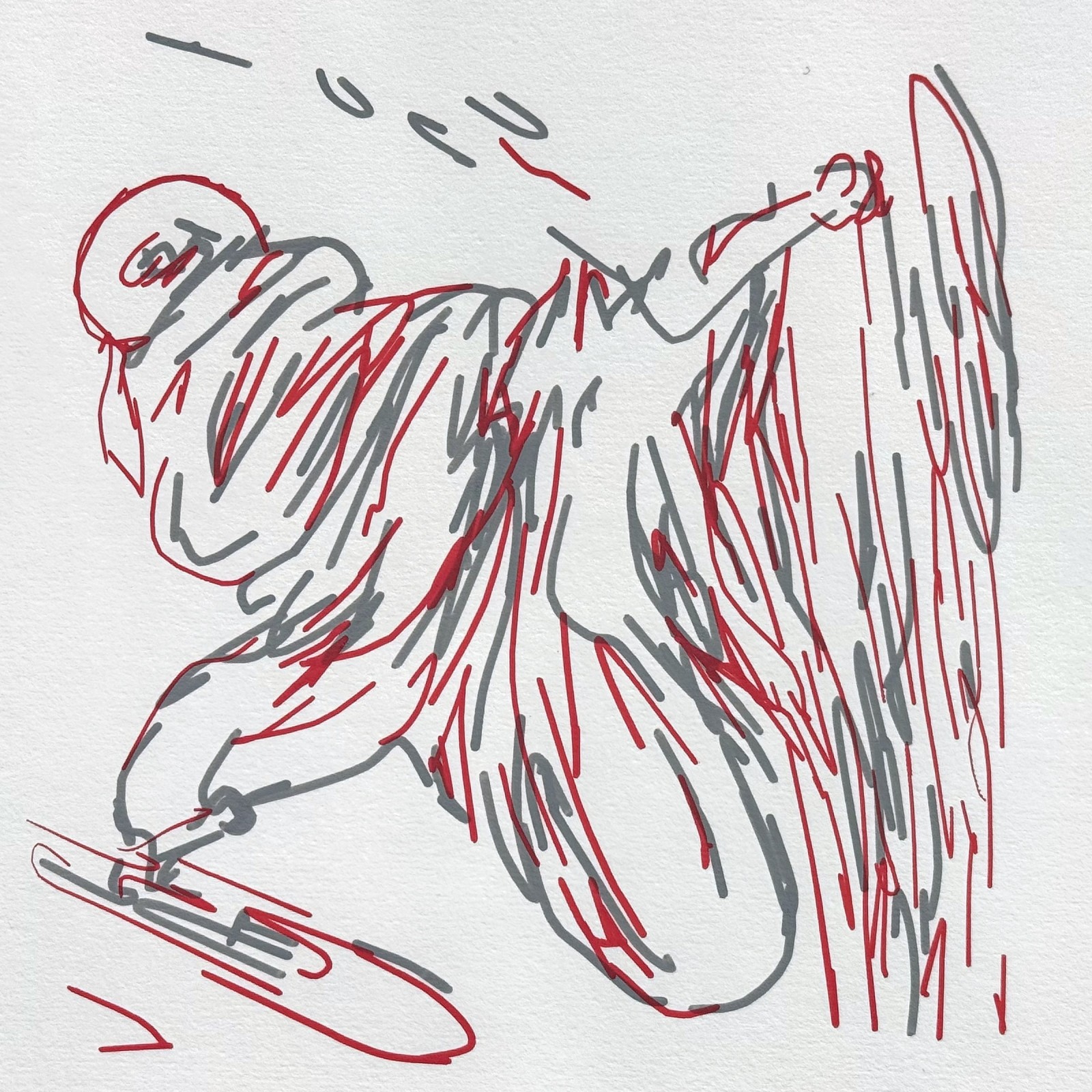
This page was grown for a single neuron, nicknamed Motam, that fires on photographs of something pushing through a medium: surfers, skiers, rally cars in dust, boats throwing spray. Two hundred short pen strokes began as random scribble and were nudged, step by step, toward whatever makes that neuron fire, with one extra rule: neighbouring lines should run the same way. Nobody drew the figure; a rider and a curtain of spray emerged. Plotted with two pens and photographed, the page fires the neuron at 13.07, against a prediction of 12.85 and a strong-photo level of 8.3. It was the first plotted page in this project to meet its prediction. On screen the smaller model also uses the neuron: switching it off changes its description about 49 times more than switching off a stand-in. That switch-off test was never repeated on the photograph, and the larger model’s description did not change at all.
2. The target and the plot


3. The neuron
Motam q27:18:2528

Motam sits in block 18 of the 27 blocks of the vision tower. The strip shows the photographs, out of 2,000 ordinary ones, where it fires hardest. What they share is not an object but a relation: a body driving through snow, water, dust or air, and the medium thrown up around it. In the smaller model the neuron at the same position follows it photo by photo (correlation 0.70 over those 2,000 photos; the next-best neuron there reaches 0.39).
4. How the page was made
The page is 200 mm square with 200 strokes and 7.43 m of line in two pens: slate grey (100 strokes, 3.57 m), red (100 strokes, 3.86 m). Each stroke is a single pass. The strokes were grown against the 27B vision tower while always being shown turned and shrunk as well as upright, so the result would not depend on one exact view. Because the first version was grown with soft-edged lines and read lower once drawn as crisp pen lines, the same strokes were refitted with a crisp renderer before packaging; they moved about 3 mm on average and the picture stayed the same.
Tom plotted it with Posca brush-tip pens as an experiment, not the fixed-width PC-3M the package was designed for. Measured on the plot, the grey lines are 1.64 mm wide and the red 1.00 mm, against a design width of 1.1 mm.
5. What the models say: screen against photograph
The neuron’s reading: screen against photograph (27B vision tower)
| Upright | Worst of 24 turns of the page | Average over the turns | |
|---|---|---|---|
| Predicted for the page as packaged (1.1 mm lines) | 12.85 | 8.25 | 12.00 |
| Photograph of the plot | 13.07 | 9.36 | 11.74 |
| Simulation redone at the measured line widths | 10.62 | 6.02 | 11.23 |
For scale: the strongest 1 % of photographs reach 8.3 and the single strongest photograph 19.9; a typical photograph reads 2.4. So the plotted page fires Motam well above its strong-photo level, and still above it when the page is turned to its worst angle. The photograph did slightly better than predicted. The simulation redone with the wider measured lines predicted less than the photograph delivered, so the simulator is too coarse about line width to be trusted in that direction.
Does the model use the neuron? (screen only)
This test was run on the page as first grown, before the refit for the pen and before plotting. The smaller model (Qwen3-VL-8B) described it as: “A dynamic sketch of a snowboarder carving down a snowy slope with motion lines emphasizing speed and action.” With Motam switched off, it said: “A skier in a red and blue sketch style is falling or sliding down a snowy slope, with motion lines indicating speed” The change in the answer was 49 times the typical change from 8 stand-in neurons, and larger than every one of them (8 of 8). Motam fired at 8.8 in the smaller model’s tower on that page.
The larger model (the full Qwen 27B) described it as: “This is a dynamic, sketch-style illustration of a snowboarder in mid-air, captured with energetic red and blue lines that convey motion and speed.” With Motam switched off its one-sentence description was word for word the same. So in the 27B the page fires the neuron (11.8) without the description depending on it.
6. What did not hold, and what was not tested
- The switch-off test was never run on the photograph, in either model. What is established on paper is the reading (13.1), not that the model uses the neuron there.
- The switch-off test on screen used the page as first grown, not the refitted version that was packaged and plotted. The two look the same, but they are not the same file.
- The smaller model’s reading of the photograph was never measured; the photograph was scored only in the 27B vision tower.
- In the full 27B, switching Motam off left the description unchanged. No stand-in comparison was stored for the 27B on this page, so there is no effect size to quote, only the unchanged sentence.
- The page is figurative: both models call it a snowboarder. An abstract page that fires Motam the way photographs do was the aim and was not reached; on the grown page the reading falls from 11.5 upright to 7.7 at the worst turn.
- It was plotted with brush-tip pens, so it is not a test of the PC-3M package as designed: the grey lines are 1.64 mm, half as wide again as the 1.1 mm design. The package’s own table says the reading falls with width (8.64 at 1.6 mm); the photograph did not show that fall.
- The pen colours in the package came from estimates made before any pen was measured (two of the suggested alternatives, emerald and english green, are pens Tom does not own).