Deep & Chrome: one drawing, two readings
Plotted and photographed 26 November 2026 · Neuron plot 03 · Tom White
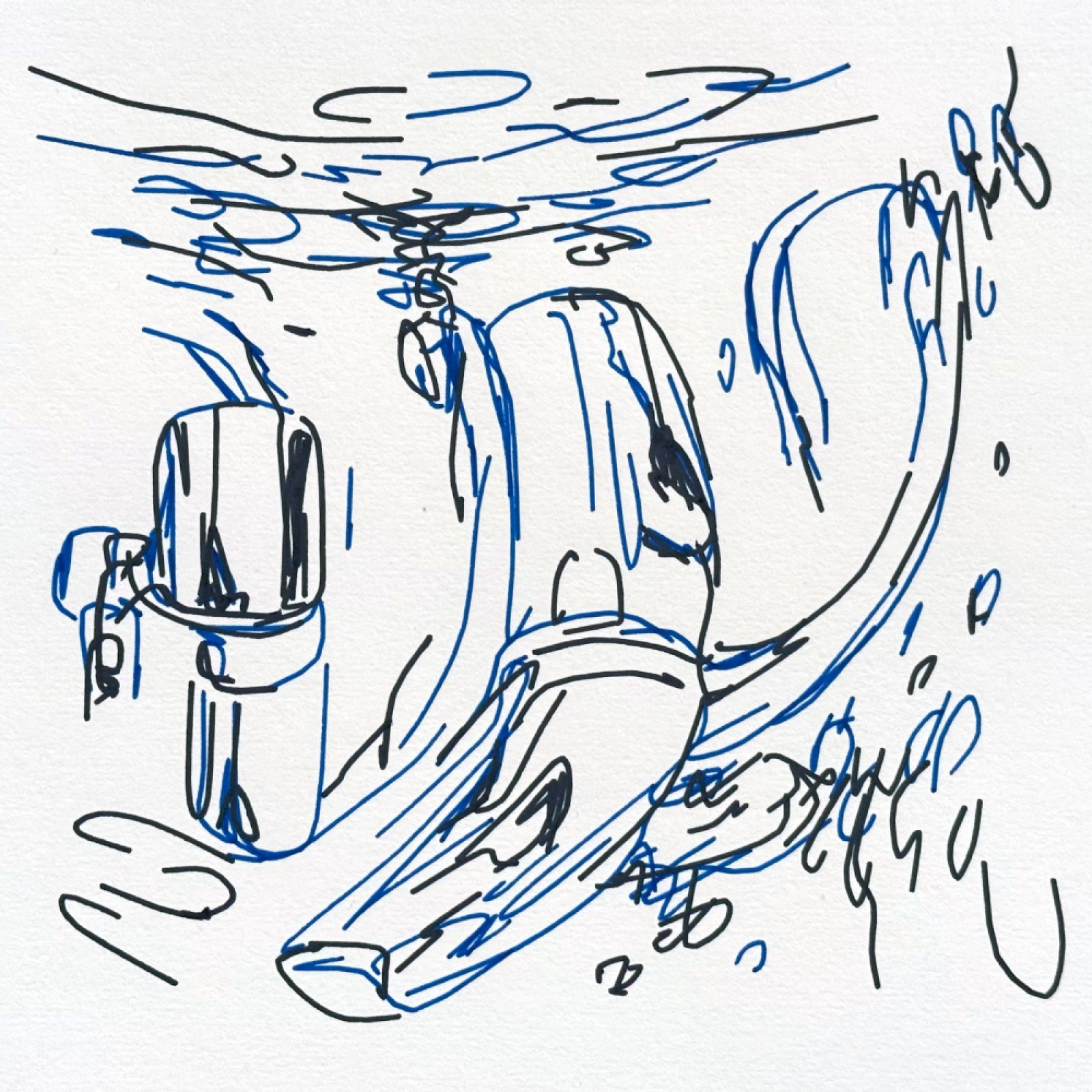
1. What this piece is, and what it showed
This page was grown for two neurons at once, over the whole sheet and in the same two pens, so nothing on it marks one subject off from the other. Deep fires on underwater scenes; chrome fires on polished metal. Asked simply to describe the page, the smaller model sees water, and the answer rests on deep: 71 times its stand-ins on screen and 33 times in the photograph of the plot, with chrome at 1.3 and 2.6. Asked what the things in the picture appear to be made of, the weight moves to chrome: 6.6 times its stand-ins on screen and 44 times in the photograph. On paper the model answers “They appear to be made of metal, possibly chrome or stainless steel, given the reflective surfa…”, and with the chrome neuron switched off the word chrome drops out of that answer. The shift from one neuron to the other by the kind of question survived real ink, and came out stronger than on screen.
2. The target and the plot


3. The neurons
Deep q27:14:234

Deep fires on underwater scenes: blue water, light from above, divers and fish. Switched off on photographs it changes the model’s answer about 7 times more than its stand-ins. On this page it was rewarded over the whole sheet and is meant to carry the first glance.
Chrome q27:23:911

Chrome fires on polished metal: taps, exhausts, mirrors, the shine on fittings. Switched off on photographs it changes the answer about 11 times more than its stand-ins. On this page it was rewarded over the same whole sheet but held lower than deep, so that it would wait for a question about what things are made of.
4. How the page was made
One 200 mm square page, 2 pens (blue and slate grey; Posca PC-3M), 200 strokes, 7.17 m of line. Every stroke alternates between the two pens regardless of where it is, so colour says nothing about which neuron a stroke serves. The strokes began as random scribble and were moved, a little at a time, to raise both neurons’ readings in two vision towers at once (the 27B’s and the 8B’s), always shown shifted, turned and shrunk so that the result would not depend on exact placement. When grown, deep read 1.71 of its strong-photo level in the 27B tower and 0.73 in the 8B tower; chrome 0.89 and 0.14.
It was plotted on an AxiDraw in two passes, blue then slate grey, about ten and nine minutes. The two pens registered within about 0.2 mm. A short bar of each pen was plotted below the page so the photograph carries its own colour reference.
5. What the models say: screen against photograph
The same five questions were asked of the screen page and of the photograph, with nothing steered and no question naming either subject. For each answer, each neuron was switched off in turn and compared with 8 stand-ins.
The smaller model (Qwen3-VL-8B)
| Question | Answer | deep | chrome | Answer with chrome switched off | |
|---|---|---|---|---|---|
| Describe this picture | screen | A blue ink sketch of a person underwater, wearing a snorkel and mask, with bubbles rising around them. | 70.7× | 1.3× | A blue ink sketch of a person underwater, wearing a snorkel and flippers, with bubbles rising around them. |
| photograph | A blue ink sketch of a submerged, broken faucet with water swirling around it. | 33.2× | 2.6× | A blue ink sketch of a submarine or underwater vehicle with bubbles and water ripples. | |
| What kind of scene, weather or atmosphere? | screen | An underwater scene with a person swimming or diving near a submerged object. | 50.3× | 1.3× | An underwater scene with a mysterious, slightly eerie atmosphere. |
| photograph | An underwater scene with a submerged object and swirling water, suggesting mystery or exploration. | 28.2× | 4.4× | (same) | |
| What material or texture do these marks look like? | screen | The marks look like quick, expressive blue ink strokes on a plain white background. | 3.7× | 0.8× | The marks look like quick, fluid blue ink strokes on a plain white background. |
| photograph | The marks look like quick, expressive blue ink sketches on textured paper. | 3.6× | 0.9× | (same) | |
| Ignoring the scene, describe the texture | screen | The surface is rough and sketchy, with uneven, expressive blue lines that suggest movement and fluidity. | 11.0× | 2.4× | (same) |
| photograph | The surface is rough and uneven, with jagged, scribbled lines suggesting a hand-drawn, textured quality. | 15.3× | 1.1× | (same) | |
| What do the things appear to be made of? | screen | They appear to be made of metal. | 1.6× | 6.6× | (same) |
| photograph | They appear to be made of metal, possibly chrome or stainless steel, given the reflective surfaces and industrial design. | 8.9× | 44.4× | They appear to be made of metal, possibly stainless steel or chrome, given the reflective surfaces and industrial design. |
Raw readings in the 8B tower barely moved between screen and paper: deep 7.18 on screen and 6.96 in the photograph, chrome 14.25 and 15.49.
The full model (Qwen 27B)
| Question | Answer | deep | chrome | Answer with chrome switched off | |
|---|---|---|---|---|---|
| Describe this picture | screen | a blue and white drawing of a faucet | 4.8× | 7.1× | (same) |
| photograph | a sink with a faucet and a hose | 4.3× | 8.8× | a sink with a faucet and a bottle of soap | |
| What kind of scene, weather or atmosphere? | screen | A bathroom sink with water running and bubbles forming. | 23.4× | 2.7× | A person is swimming underwater in a pool or ocean. |
| photograph | A calm, serene underwater scene with gentle ripples and bubbles rising to the surface. | 13.6× | 4.3× | (same) | |
| What material or texture do these marks look like? | screen | The marks resemble a blue ballpoint pen sketch on white paper, characterized by fluid, continuous lines and varying line weights typical of ink on a smooth surface. | 2.6× | 1.8× | (same) |
| photograph | The marks resemble a quick, gestural ink or marker sketch on paper, characterized by loose, expressive lines and a lack of fine detail. | 1.6× | 1.1× | The marks resemble a loose, gestural ink or marker sketch on paper, characterized by fluid, overlapping blue and black lines that suggest a quick, expressive drawing styl | |
| Ignoring the scene, describe the texture | screen | The surface appears smooth and glossy, with reflective highlights suggesting a polished, metallic or ceramic material. | 2.5× | 22.3× | (same) |
| photograph | The surface has a smooth, glossy finish with sharp, reflective highlights. | 1.4× | 11.7× | The surface has a rough, textured quality resembling paper or canvas with visible grain. | |
| What do the things appear to be made of? | screen | metal | 3.5× | 9.0× | (same) |
| photograph | metal | 3.2× | 17.6× | (same) |
On the photograph the larger model also puts the made-of answer on chrome: 17.6 times its stand-ins (on screen 9.0), with deep at 3.2. At first glance deep is 4.3 times and chrome 8.8 times (on screen 4.8 and 7.1).
6. What did not hold, and what was not tested
- On screen this page did not pass the full test: the neuron moved, but the made-of answer stayed “They appear to be made of metal.” with chrome switched off. On paper the answer does change (the word chrome goes), so the paper result is stronger than the screen result it was chosen on. That is one photograph of one plot.
- Chrome is not silent at first glance on paper: 2.6 times its stand-ins for the plain description and 4.4 for the scene question in the 8B (on screen 1.3 and 1.3). The strict bar asks for under 2, so by that bar the first-glance half fails on paper; deep still outweighs it by more than ten to one.
- The made-of question was added after the two planned questions about material and texture had been answered about the ink (“quick, expressive blue ink sketches on textured paper”). It names neither subject, but it was chosen after seeing results, and on both those planned questions neither neuron’s share changes in the intended way.
- The slate grey pen photographs as a dark charcoal (about #2e373a), far from the mid blue-grey (#4e84a2) the page was grown with. The models were therefore shown a darker, higher-contrast page than the one tested on screen. The effect grew; we do not know how much of that is the darker pen.
- The blue line came out narrower than designed (0.84 mm against 1.1 mm; slate grey 1.04 mm), and every stroke end stops about 1 mm short, a trimming mistake in the plotting session.
- The other two seeds of this pairing were not plotted. On screen, seed 1 showed the same shift in the 8B and seed 0 did not.
- Inkling 2 Mini has no version of this question-type test yet, so the page is untested in a third model.
- In the full 27B there is no first-glance half at all: chrome already outweighs deep for the plain description, on screen (7.1 against 4.8) and on paper (8.8 against 4.3; it describes a sink with a faucet). What the 27B does show is deep carrying the scene question and chrome carrying the texture and made-of questions.